
I have been photographing for the past 10 years. It’s not always been about food, but I have been consistently obsessed with objects and details, the interest that finally evolved in the food photography pursuits. My first food shots (no links here) were awkward: electric lights on, wicked plates, random props and unappetizing food. Who did not start there? Now I am more often proud than embarrassed with my work, I get occasional compliments, I was invited to contribute to Getty Images, and people even pay money for my shots.
Enough shameless bragging. I have surely improved, but I have also learned a helpful photography tip by Scott Kelby: always show your best work. Indeed, no one needs to know it took you a two hundred shots to get this perfect one.
Encouraged by your kind words and questions (in particular, a big thank you to Claudia) I have put down some thoughts on food photography based on my experience.
1. Know Your Equipment
You don’t have to be geared from head to toe in order to take great photos, but if you understand essential equipment, you know your possibilities and limitations. I believe in gradually progressing to the advanced cameras as you grow out of the equipment you have been using. Buying Mark III will not solve it if previously you only used a point-and-shoot.
For the long time, I was shooting with Canon Powershot A70, a point-and-shoot with standard pre-set modes and also manual settings. I had used the hell out of the camera: when I held a personal photo exhibition on my 25th birthday in my hometown I got a lot of questions about my equipment and even lenses. By that time I had never held a camera with a detachable lens! Preparing the exhibition encouraged a big revision of my work, and after going through the hundreds of my shots, I knew I was ready for a new camera.
The next was Olympus E510 with two lenses - a whole new world of possibilities. Through using this SLR I started understanding the light and also physics of the lens. After the blurred photos I took with a zoom lens at a horse jumping competition in a riding hall I knew it was time to upgrade to the camera and lenses that could handle pour light conditions better.
For the past 4 years I have been using Canon EOS 50D with three lenses: 50mm f/1.8, 17-55mm f/2.8 and 70-200mm f/4. Now, lens matters more than the body, and you should think twice when choosing a lens. There is hardly a universal lens, but as far as the food photography is concerned 50 mm is excellent; it is also a good example of 80/20 rule when 20% investments gives you 80% returns: it’s cheap, light and helps you present food in the best light. So most of the time this is the default lens attached to my camera.
I have been also using tripods that I have been upgrading along with the cameras: from a 15 cm table top tripod that was perfect for the point-and-shoot Canon I have progressed to carbon fiber Manfrotto 190CX3 with Manfrotto 496rc2 ball head: it is light for its bearing capacity and steady enough to hold my camera with my heaviest lens on it. Adding an extra element to your gear may seem to limit you: after all it is one more thing to carry/ keep / use around (I can tell you after a multi-day hike in the Kyrzyz mountains with my whole gear). But the benefits of using tripod are serious: tripod boosts the sharpness of your photos many folds, helps you do better in the low light conditions and also lets you frame your shot and then experiment with the styling and settings to your heart’s content.
Reflectors might be an overkill even for a very enthusiastic food blogger, but they are serving a very good cause: they are bouncing off the light on your dish minimizing the shades and making your food look vibrant. The good news is that there are decent DIY alternatives you can make out of the items found at every kitchen: white cutting board, large white towel/ sheet hanged on a chair, aluminum foil or silver foil cards from takeaway packages are perfect DIY reflector solutions for food photography. In the restaurants you can use menus (if white) for the same purpose.

2. Aim for Best (Natural) Light
“Look at that light!!!”- my photography-obsessed friend Olesya used to announce, and I used to shrug my shoulders: I obviously did not see anything. But with time I have learned to register the moments of outstanding light. You just know it when the right light is there: your dish that looked grey and casted long shade a second ago radiates vibrance and invites you to set your camera aside and start the feast immediately. The right light is 90% of the success behind a photo. And the right light is natural light. Previously I used to photograph dinners at the poor-lit restaurants or use a few lamps to brighten up the meals I cooked in the late afternoon. These days I just do not bother.
I schedule my meals out around lunch time (and make sure to reserve a table by a window). I plan my cooking in a way that I have a ready dish between 2 pm and 4 pm, the time when I have perfect natural light in my Istanbul flat. Like in many Istanbul apartment the light is scarce in mine: my kitchen / living room has large windows, but I still don’t have enough light in the depths of the kitchen. When I shot the prep I use shallow depth of field and then remove the noise with Noiseware plugin for Photoshop. Or I just take my cutting board closer to the window for better light. I shot all the final dishes right by the window with all electric lights turned off. At the countryside it’s easier to plan; a large wooden dining table is right in the corner and exposed to the light coming from the two windows, so there I could do my prep and photograph from the very morning until 3 pm or so.
It is much easier for me to be organized and shoot when you have the best light rather than spend endless hours twinkling RAWs and trying to give some life to the dull looking food. I feel that even basic processing in Photoshop takes a while, and I don’t want to increase that time. Find the natural light or forget it.
3. Tell Story With Your Photos
What makes photographs stand out? Yes, they might feature beautiful foods and smiling people, but most importantly - they tell a story. Your story. Do you want to take your reader to the vendors you shop from? Or walk them through your preparation process? Or possibly show how the meal was eaten by your happy family or friends? You need to think about this before even touching your camera. What’s your story?
I think it’s important to tell your own story and not somebody else’s. I love “beautiful mess” photos, but I can’t do beautiful mess: my kitchen has just two states - mess or beautifully clean. As you are trying to find your voice it is fine to benchmark and try to imitate the work of others, but eventually - just like with writing - you need to find your own voice to tell your own story.
My story is about what it takes to cook a certain dish. It is about the ingredients I use: I want you to see the kind of peppers or eggplants we get here, so you could look out for them next time you buy produce. I want to showcase the traditional Turkish cooking utensils I use. And if course, I want to show you the key parts of the prep such as the size of the cut or some rolling tricks because photos explains the process way better than the long-long text. For me this is more interesting than photographing the final dish surrounded by a lot of pretty props. But then this is my story.
4. Style While Cooking
I don’t use a lot of props because 1) I try to be minimalistic in my possessions; 2) It is hard to find pretty and durable non-white bowls in Turkey and 3) I am not very comfortable with buying old junk as I believe that things like humans have their own karma, and you can’t be exactly sure when you are buying the stuff someone else owned. But then I have a weak spot for textiles: I use them extensively at the kitchen, and occasionally you can see them featured in the shots. I feel that even including a narrow strip can make a big difference for a food photograph. If you use only few props, you need to work harder in the food styling department.
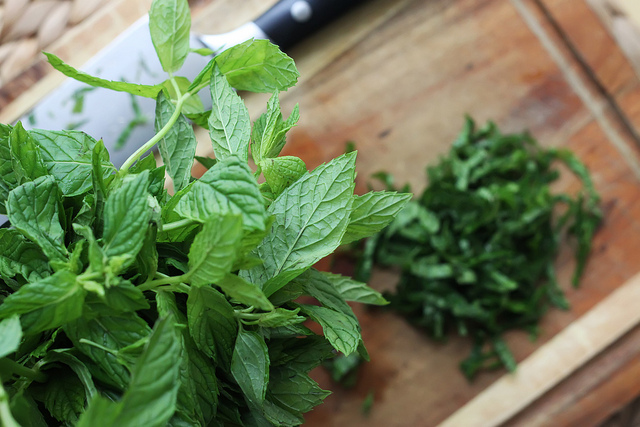
For me food styling starts with cooking. I cook my own food, so I try to make it look good whether I am photographing or not. I pay attention to a few things. One is chopping. Through my cooking classes I have learned how many home cooks are arbitrary with chopping; but how you cut ingredients has a big impact on the cooking time, resulting texture and the look of the finished dish. If you prepare a salad, you want different ingredients to appear in the matching chunks or slices creating an overall balanced look. Second is the cooking style: I love roasting and I prefer chunky dishes where ingredients are not purred bur rather kept whole. This kind of food is photogenic by definition. And finally, the color. When I worked with talented chef Saša Obućina at his restaurant in Sarajevo he taught me how to cook by color, or to combine the ingredients in the dishes to create a balance of colors pleasing to the eye and soothing to the soul. That’s why when you cook with green lentils you are going to balance it with, say, red. When you poach quince in the sugar syrup to that stunning deep ruby color you want to add a bit of white (clotted cream) or green (ground pistachio) when serving it. Once you got your chopping, cooking and colors right there is not much styling left.
If you photograph a dish in a restaurant in Turkey .. well, good luck with the white plates, white table clothes and often eccentric approach to food styling. However, you should be able to ask for the additional seasonings that are readily available at any restaurant kitchen (e.g., parsley, lemon wedges, tomato slices and red pepper flakes). And after this emergency styling focus on the next step - finding a good angle and composing your shot.
5. Plan Your Shot
You should have your setup ready by the time the food is cooked. Natural light, background or surface where you are placing the finished dish, plates, textiles and other props you are planning to use in the shot. Camera, lens, tripod, reflector. Shooting food is time-sensitive, and you don’t want your food to lose a single bit of its appeal. Dishes get cold, chucks sink the soup, fried or grilled food looses it shine. I try to do a few test shots with the empty plate and maybe a small object of the color resembling the color of my dish as a placeholder: at this point you should be able to settle on a good angle and cropping.
Speaking of the angles, for the long time I was shooting from the 45 degree angle. This was until I first saw stunning photographs of David Hagerman, master of overhead shots: he positions his camera parallel to the plate or the table. His photos of the meals he and Robyn had in Turkey are the most fascinating I have ever seen: they showcase not only the food but also bits of local food customs. I started applying this trick for both home-cooked dishes and outside meals: I was able to come up with the shots I never thought I could produce. In fact, overhead is my most favorite angle for the food photographs now.
When preparing your dish for a shot what you often want to do is to create layers: a backdrop (e.g. garnish or broth), the main (e.g. meatballs or chunks in the soup), then the sauce or seasoning. The layering technique is particularly important for salads: instead of mixing it all you layer the ingredients on the plate and drizzle with your dressing. For the final layer I use a lot of fresh herbs and spices such as red pepper flakes, sumac or dry oregano, and they look great on the photos.
After you have done the actual shot, you want to look at the screen carefully: it is on the screen you notice an oddly sticking out herb or a lonely crumb. They are much easier to fix or remove now than later in Photoshop.

6. Participate in Online Photo Communities
As long as I have been photographing I have been participating in the online photo communities where you can share your work and view that of others. I have learned a lot from reviewing photographs of different genres and getting critique on my own work. I believe there is a right community for everybody, and you don’t have to be everywhere. For instance, I found intimidating to be a female contributor to many Russian photography portals that are dominated by the professional male photographers sharing stunning landscapes … and a lot of nudity. But then I found communities like TrekEarth with many exceptional photographers contributing their work and generously sharing their critique.
For the long time I have been participating in the websites like foodgawker or tastespotting: they are giant depositories of food photos you can study and learn from. Very convenient when you want to photograph a soup and get a few ideas while planning your shot.
Flickr is by far the greatest photo sharing and community building service for amateur photographers I have come across. Like with all the online social communities the returns are not immediate: it takes a while to create a portfolio, build relationships through joining groups or following others photographers and food bloggers and then start getting comments about your work.
7. Learn from Photographers You Admire
Being a former consultant I started my food blogging in a proper way - by studying best practices. I found The Time’s list of top 50 food bloggers and included them all in my reading list to benchmark their writing, recipes and food photography. My reading list has long changed, but still every week I go through over 50 food blogs and culinary magazines I love and not at least for their photography. I pin down (often - literally to my Pinterest board) the ideas I love about food styling or angles and get back to them next time I cook and photograph a similar meal.
Don’t stop at looking. It does not hurt to reach out to the photographers you admire and ask them questions. And even better - see them in action (many run online courses and actual workshops these days). Even though I spent most of our cooking and photography workshop at the kitchen I made sure to pop in a few sessions when David was sharing his food photography tips. Observing a pro in action is a life-changing experience: you get to see the equipment that you did not know exist and tricks that you can start applying right now. And, by the way, David is back in April for more.
***
Having said all that if I were to give only one advice about improving your food photography here it goes: don’t procrastinate over what you think to be imperfect shots. Share them and move on. Photograph and post, photograph and post. In my book, quantity always turns into quality if you are sufficiently determined: after shooting thousands of food photographs you will inevitably improve.
I would love to hear about your food photography experiences: please, feel free to share your tips or ask any questions.




Great post as usual. Great advice! Thank you. I still got a lot to learn.